

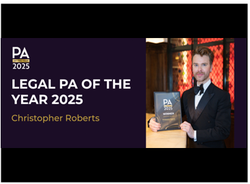
Following the PA of the Year Awards in December 2025, ILSPA partner SecsintheCity caught up with 2025 Legal PA of the Year winner Chris Roberts, Executive Assistant to the General Counsel and Company Secretary at The Francis Crick Institute. Chris reflected on his transition from the creative arts to high-stakes scientific and legal environments, the distinct boundary between the EA and Chief of Staff roles, and why human intuition remains an indispensable career superpower.
How did you become a Legal EA?
My route into the profession was anything but linear. I began my career in the creative industries, working as an actor, and then as an assistant to a theatre director and West End producer. That environment taught me that effective support is as much about emotional intelligence and judgement as it is about process. When the pandemic hit, I pivoted quickly into biomedical science—at a moment when clarity, trust, and good decision-making really mattered.
Working in high-stakes scientific environments reshaped how I see the role. Business support, at its best, is not reactive; it’s strategic. One particularly formative experience was supporting Professor Edith Heard on an interim basis as she transitioned into her role as CEO of the Crick. Being trusted to operate alongside a leader at such a pivotal moment reinforced the importance of discretion, deep contextual understanding, and calm continuity.
I’m Australian by background, and I think that has shaped my approach in important ways. I’m used to working in more egalitarian environments, where openness, clarity, and mutual respect underpin effective leadership. I bring that sensibility into my work—creating space for honest conversation, reducing unnecessary hierarchy, and helping leaders operate with focus and intent.
In 2024, completing Chief of Staff training at Harvard Business School in Boston—supported by a partial scholarship from the Chief of Staff Association—further sharpened my thinking. It clarified the distinction between the EA and the Chief of Staff, and reinforced my belief that EAs are evolving into strategic advisors in their own right, working alongside executives but in a distinct role. As the future of work becomes more complex, that blend of strategic insight, human judgement, and clarity is becoming more essential than ever.
What key skills help you succeed in your role?
For me, the heart of this role is emotional intelligence and discretion. Everything else—planning, organisation, governance—can be learned, but the ability to read people, understand motivations, and navigate complex personalities with warmth and subtlety is what truly sets exceptional EAs apart. Day to day, that skill makes the biggest difference. It allows you to anticipate challenges, smooth interactions, and create an environment where leaders can make confident, clear decisions.
I’ve developed it over years of experience in diverse, high-pressure environments. What I’ve learned is that empathy and diplomacy are not optional extras; they are the foundation. The EA who can negotiate different personalities with ease, and who can maintain trust while keeping everything moving, ultimately succeeds. It’s a deeply human skill, and in a world that often emphasises tasks over people, it’s what elevates the role into a strategic partnership.
Can you share a memorable moment or aspect of your work that you feel contributed to your win?
What I think really defines my approach is seeing myself as an advisor rather than just an executor. In some organisations, EAs can be perceived as functionaries—keeping diaries, managing logistics, and ticking boxes—but the reality is often very different. The best support comes from quietly laying the groundwork, understanding the broader context, and having a finger on the pulse of people, priorities, and politics.
I’ve always approached the role as if I’m briefing myself before I brief my executive—reading widely, staying informed, understanding dynamics, and anticipating challenges. That allows me to provide guidance, insight, and clarity in the moment, while maintaining absolute discretion and trust.
It’s that combination of strategic foresight and human insight that I think has defined my work and ultimately contributed to recognition like the Legal PA of the Year award. For me, being able to operate in that space—bridging execution with advice, and insight with action—is what makes the role so impactful.
Would you say you learnt anything about yourself and your role during this process?
What struck me most during this process was how much the future of executive support will rely on human intelligence rather than technical skill alone. The role has always required organisation and diligence, but increasingly, the people who excel are those who can navigate emotional complexity, read between the lines, and foster collaboration across diverse personalities.
I see a new era emerging—one in which high-level support is less about reacting to demands and more about shaping outcomes. It’s about helping people work together more effectively, coaching, influencing, and quietly guiding decision-making without ever stepping into the spotlight.
The EA role, at its best, becomes a kind of connective tissue: holding teams together, anticipating tensions before they arise, and enabling leaders to operate at their highest level. That’s the frontier of this profession, and it’s what excites me most about the work I do today and in the years ahead.
How did you find the awards process?
I was genuinely delighted that a colleague had nominated me. That, more than anything, spoke to me about the power of supporting and lifting up your fellow colleagues — and recognising that it really takes a community to make things happen. It was a wonderful reminder that this work is never done in isolation.
It probably won’t come as a surprise that the interview itself felt less like an assessment and more like a chat with good friends. It reflected exactly what I think is at the heart of this role: warmth, empathy, and the ability to connect with people. Those qualities, more than anything else, enable us to navigate complexity, build trust, and help leaders and teams thrive.
Do you think being a winner at the PA of the Year Awards will positively impact your career?
I think the biggest impact has already happened—in the connections I’ve made along the way. Meeting so many people who are passionate about improving how we work has been energising and inspiring, and it reminded me how much we can learn from each other when we share ideas and experiences.
In the short term, it’s a lovely acknowledgement of the value of thoughtful, human-centred support. In the long term, it gives me a platform to help shape how the profession is seen—to champion the idea that EAs are collaborators and advisers, not just organisers.
More than a personal accolade, it’s a way to share what works, spark new conversations, and hopefully encourage others to think differently about the role we play in organisations.
What advice would you give to someone wanting to take part in the awards next year?
My advice is simple: make sure your colleagues know about the awards, and make sure your executives know too. Recognition often comes from others, and it’s easy for amazing work to go unnoticed unless people are aware it exists. The process reminded me how much this profession thrives on community and support, and it inspired me to do the same—I’ll definitely be nominating someone next year.
It’s a brilliant way to celebrate the contribution of the people around you, and to reflect on how much impact can be made quietly, every day.